Want the method itself, with all its variants? You can see the full 50/30/20 method page in SmartJib.
What you will find in this article
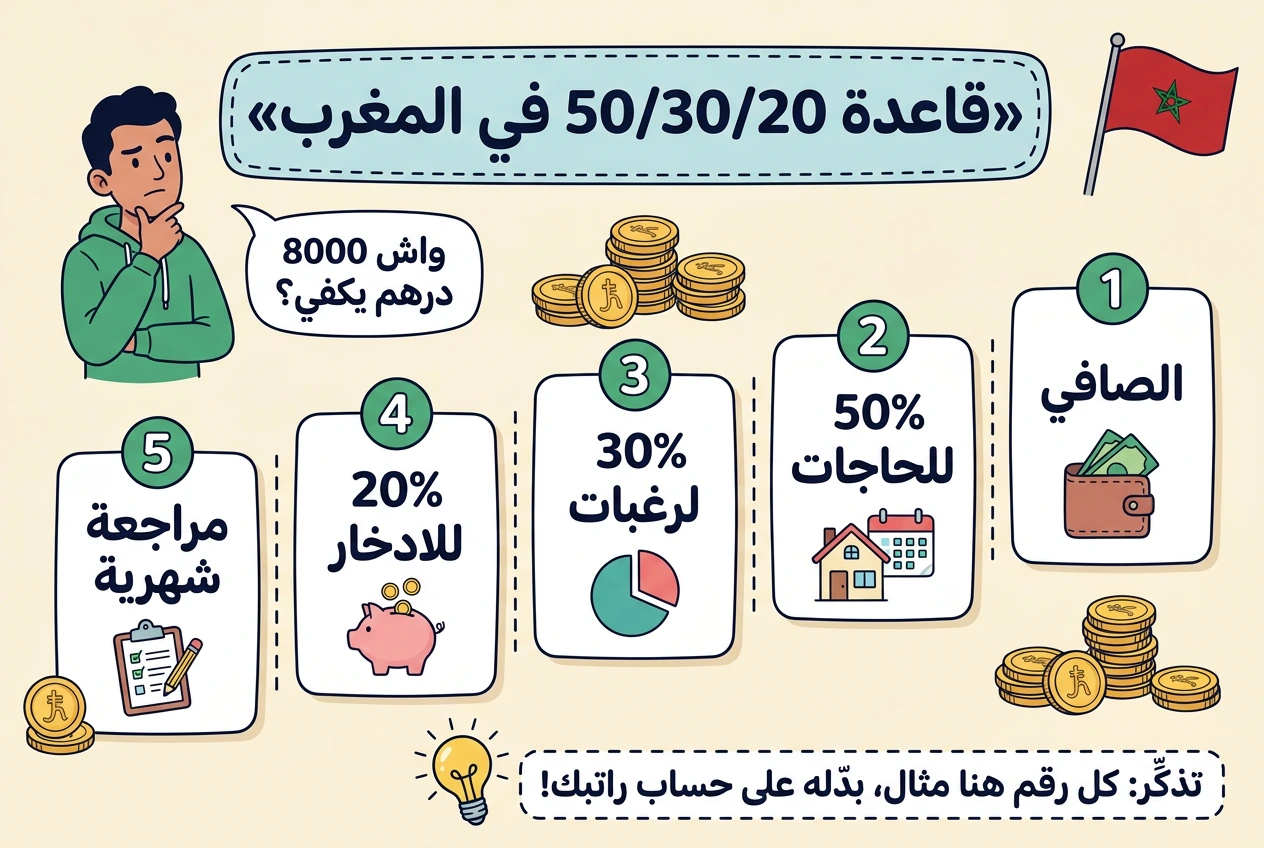
The 50/30/20 rule is the simplest budget split that still covers everything: half of your net salary goes to needs, 30% to wants, and 20% to savings and debt repayment. On a Moroccan salary of 8,000 MAD net per month, that means 4,000 MAD for needs, 2,400 MAD for wants and 1,600 MAD saved — decided before you spend a single dirham. This article explains where the rule comes from, walks through that 8,000 MAD example line by line, and shows what to change when your rent or income does not fit the template.
- What 50/30/20 means in plain language
- A worked example on 8,000 MAD net per month
- The four steps to set it up in one evening
- What to do when 50% is not enough for rent
- How to adjust the rule every month without guilt
Where the 50/30/20 rule comes from
The rule was popularised by the American senator Elizabeth Warren in her book All Your Worth. The idea is deliberately blunt: if your needs eat more than half of your income, the budget — not you — is the problem, and something structural has to change: housing, transport, loans.
It is a guideline, not a law. In Morocco it works well for salaried employees with a stable net income, because Moroccan payslips state the net amount clearly after CNSS, AMO and income tax (current contribution rates on cnss.ma, accessed October 2026). For irregular income, the zero-based method fits better.
What counts as needs, wants and savings in Morocco
Needs are the expenses you cannot skip without real consequences: rent, groceries, transport, electricity and water, phone, school fees, minimum debt payments. Wants are everything that makes life nicer but is optional: restaurants, subscriptions, new clothes, weekend trips. Savings include your emergency fund, a concrete goal, and zakat if you pay it from savings.
The Moroccan specifics matter here. A large share of daily spending is still cash, so wants often leave your wallet without a trace. And rents differ enormously between cities: a small apartment in Casablanca commonly costs 3,000 to 5,000 MAD, while the same space in a smaller city can cost half that (example figures, HCP household survey 2023–2024, hcp.ma, accessed October 2026).
- Needs: rent, groceries, transport, utilities, school, minimum loan payments
- Wants: restaurants, subscriptions, outings, non-essential shopping
- Savings: emergency fund, goals, investments, zakat
- Rule of thumb: if you can live without it this month, it is a want
Worked example: 8,000 MAD net per month
Let us take a single employee in Casablanca earning 8,000 MAD net per month (example). Under 50/30/20: needs get 4,000 MAD, wants 2,400 MAD, savings 1,600 MAD.
Inside the 4,000 MAD of needs, a realistic split could be: rent 2,200 MAD (example), groceries 900 MAD, transport 250 MAD, electricity, water and phone 350 MAD, other fixed costs 300 MAD. That adds up to exactly 4,000 MAD, with no slack — which is why the next sections matter.
- Needs 50% = 4,000 MAD: rent 2,200, groceries 900, transport 250, utilities + phone 350, other 300 (example)
- Wants 30% = 2,400 MAD: restaurants, outings, subscriptions, shopping
- Savings 20% = 1,600 MAD: 1,000 MAD emergency fund, 600 MAD concrete goal
- Every amount here is an example to adapt, not a target to hit
Step 1: know your real net income
Start from the net amount that actually lands in your account, not the gross salary on your contract. In Morocco that is the amount after CNSS (employee share around 4.48%), AMO (around 2.26%) and income tax (IR); the exact scale changes over time, so check the current one on tax.gov.ma, accessed October 2026.
If your income varies (auto-entrepreneur, seasonal work), budget on the lowest month of the last six months. Budgeting on an optimistic average is the fastest way to "fail" a budget that was never realistic.
- Use the net amount that arrives, not the gross on the contract
- Irregular income: budget on your worst recent month
- Note extra income (family help, side work) separately and do not rely on it
Step 2: list your fixed expenses — the 50%
Fixed expenses repeat every month with roughly the same amount: rent, loan payments, insurance, subscriptions, school fees. List them all, add about 10% for the ones that drift (electricity in summer), and compare the total to 50% of your net income.
If the total is above 50%, act on the three biggest levers in order of impact: housing (the largest expense category for Moroccan households, HCP 2024, hcp.ma, accessed October 2026), transport, then loans. Cutting wants will never fix an oversized fixed base.
- Rent, loans and school usually fill most of the 50%
- Add a ~10% buffer for drifting bills (electricity, water)
- Above 50%? act on housing or transport, not on coffee
- Below 50%? the slack is yours — send it straight to savings
Step 3: cap your wants at 30%
Wants are where Moroccan budgets usually leak, because so much spending is cash. The fix is not willpower, it is a weekly cash envelope: withdraw the 30% at the start of the month, or one quarter of it each week, and when it is gone, it is gone.
Restaurants, cafés, delivery apps, small purchases — all of it comes out of this envelope. When you track even roughly where it went, you will be surprised how much "nothing" costs: unlogged cash purchases are the classic reason a 30% cap feels impossible.
- Withdraw the 30% in cash at the start of the month
- Split it into four weekly envelopes
- Log every expense in seconds — cash included
Step 4: automate the 20% savings
Savings work when they happen before spending, not after. On payday, move the 20% to a separate place: another account, a dedicated savings goal, or a labelled envelope at home. What matters is that the money leaves your spending flow immediately.
In SmartJib you can create a savings goal with a name and a target amount — for example "emergency fund, 24,000 MAD" (example: three months of an 8,000 MAD salary) — and watch the progress fill up. Your plan puts the 20% there automatically.
- Move the 20% on payday, before anything else
- Give the money a job: emergency fund first, then goals
- 24,000 MAD = three months of an 8,000 MAD salary (example)
- One funded goal beats five half-funded goals
When 50/30/20 does not fit your life
The rule assumes a stable salary and a rent below half of it. Many Moroccan households are not in that situation, and that is normal: in large cities rent alone can eat 40 to 50% of a modest salary (example, HCP 2024, hcp.ma, accessed October 2026). With inflation running low — around 2% in 2025 (Bank Al-Maghrib, bankalmaghrib.ma, accessed October 2026) — the pressure comes from prices, not from runaway inflation.
In that case use a 60/20/20 or even 70/20/10 split, or switch method: zero-based budgeting gives every dirham a job and is stricter about wants, while the envelope method is better when cash spending is the leak. The method matters less than the habit of looking at the numbers once a month.
If you want one tool for the whole picture, track bank, home and wallet as separate balances in SmartJib, so a heavy cash week does not silently become "missing money".
- Rent-heavy budget: try 60/20/20 or 70/20/10
- Irregular income: switch to zero-based budgeting
- Cash leaks: envelope method plus quick logging
- Never guilt-trip yourself: adjust the percentages, keep the habit
Review and adjust every month
A budget is a living document. At the end of each month, spend fifteen minutes: compare planned versus actual for each category, note the surprises (a wedding, a repair, Ramadan), and adjust next month’s percentages. Three months of reviews are enough to reach numbers that genuinely fit your life.
Celebrate the wins too: if you saved the full 20% three months in a row, raise the goal or move the surplus to a bigger one. Small, consistent reviews beat a perfect budget abandoned in February.
- Fifteen minutes at month end: planned vs actual
- Note the surprises, adjust next month
- Three months of reviews = realistic percentages
- Saved the full 20%? raise the goal
Decision check: treat 50/30/20 as a guideline, not a mandate
The 50/30/20 split applies to take-home income: roughly 50% needs, 30% wants and 20% savings or debt reduction beyond required minimums. It is a starting point, not a rule to force onto a household whose essential bills already exceed half of income.
On 8,000 MAD net, the illustrative targets are 4,000 MAD, 2,400 MAD and 1,600 MAD. If your actual essential bills total 4,600 MAD, first fund them and revise the remaining targets transparently. Do not hide rent or required debt payments under wants to make a percentage look right.
SmartJib
Frequently asked questions
Is 50/30/20 realistic in Morocco?
Yes for many salaried employees, with one caveat: housing. If rent is below about 40% of your net salary the rule works almost out of the box; above that, use a 60/20/20 split instead of blaming yourself. The percentages are a starting point, not a contract.
Should the 20% savings come from gross or net salary?
From net. The gross salary includes CNSS, AMO and income tax that never reach your account, so 20% of gross is money you do not have. Always split the amount that actually lands.
What if my rent alone is more than 50% of my salary?
That is a structural problem, not a discipline problem. Options: a smaller place or a roommate, moving to a cheaper area, or increasing income. Meanwhile budget with 60/20/20 or 70/20/10 so the plan stays honest and you keep saving something.
How do I track cash spending in Morocco?
Log every expense the same day, even 20 MAD coffees — it takes seconds and cash is exactly where budgets leak. Keeping your wallet as a separate balance from your bank account (SmartJib does this: bank, home and wallet are tracked separately) stops a heavy cash week from looking like missing money.
Can I use 50/30/20 as an auto-entrepreneur?
Yes, but base it on your average net income over the last six months, and treat your lowest month as the safety reference. Auto-entrepreneur income swings, so review the percentages every month rather than once a year.
SmartJib keeps budget envelopes separate from bank, home, and wallet balances.
Also: Budget tracker MAD guide · 4 budgeting methods explained · Why SmartJib is private by design
Educational content, not financial advice. Figures are worked examples; verify rates and rules with the official source. Editorial policy.