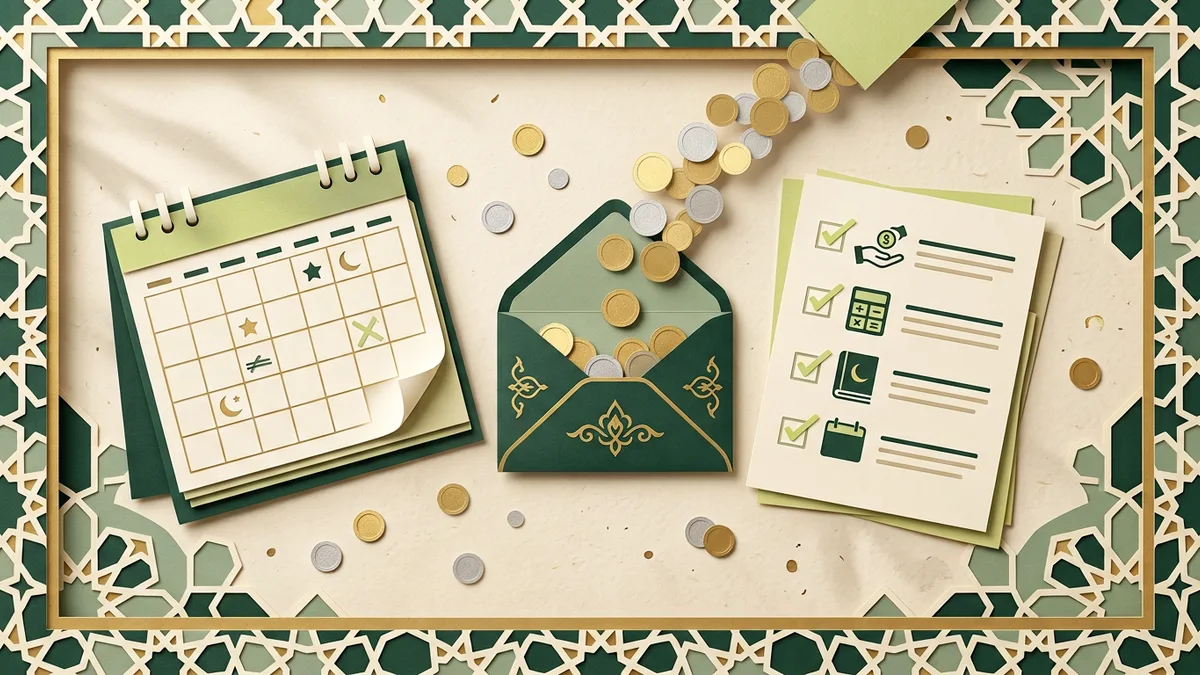
Plan before your assessment date
A zakat estimate can help you set money aside, but it is not proof that an obligation is due. Wealth, eligible debts, metal prices and the relevant conditions may change before your assessment date.
List the information you will need: balances, qualifying assets, relevant debts, your chosen basis and the estimated lunar anniversary. Review your situation and any uncertainty with a qualified scholar.
Build a manageable reserve
For a fictional illustration, if you expect an eventual amount of 3,000 MAD and have six months to prepare, setting aside 500 MAD per month reaches that estimate. This is budgeting arithmetic, not a determination that 3,000 MAD will be due.
Keep the reserve distinct from emergency savings and obligations already committed elsewhere. Recalculate when the actual assessment is made; do not treat money moved into a reserve as a payment to a beneficiary.
Record payments and their context
Once you have actually paid, record the date, amount, currency and recipient if useful, along with the year or cycle the payment relates to. Keep any receipts separately. A ledger entry is a record, not a bank transfer.
When tracking partial payments, compare only amounts in the same currency and assessment cycle. A remaining balance based on a changing assessment is an estimate; check whether advance payments and allocation to a particular cycle are appropriate under the guidance you follow.
Avoid common record-keeping errors
Do not add payments from a different currency or year without an explicit, appropriate conversion and attribution. Keep an old legacy record separate if you cannot tell which cycle it belongs to, so it is not silently counted twice.
A partial payment does not automatically settle an obligation or reset the hawl. If an entry is wrong, correct your record; deleting it does not reverse a transfer already made.
Use reminders and verify the recipient
A calendar reminder can prompt an early review, but a reminder is neither confirmation of eligibility nor proof of payment. Verify the recipient and the relevant zakat rules before giving, and seek trusted local guidance where needed.
In SmartJib, the payment record is stored on your account for the selected workspace; it does not send money. A downloaded calendar event must be imported into your own calendar to use its alert.
Build a simple payment log
For each actual payment, use one entry with the date, amount, currency, recipient if appropriate and the cycle you intend it to cover. If a receipt is available, keep it separately. Never enter a planned payment as though the money has already left your account.
For example, two confirmed payments of 1,000 MAD and 500 MAD in the same cycle total 1,500 MAD. If the verified obligation is 3,000 MAD and those payments are applicable, the arithmetic remainder is 1,500 MAD. Both amounts are hypothetical.
Review the log when circumstances change
If the assessment changes, compare the new verified amount with the payments properly assigned to that cycle. Keep a note of the calculation and advice rather than silently overwriting the original record. Different currencies require an explicit conversion decision.
A missed reminder does not itself erase a responsibility, and a saved entry does not confirm delivery to the recipient. Check your payment provider or receipt and consult a qualified scholar if timing or allocation is uncertain.
Choosing and verifying recipients
Before paying, decide clearly who will receive your zakat: a close relative in need, people in difficulty, or recognised charities. Check the legitimacy of the organisation and keep proof of the payment.
If you pay cash to an individual, note the date, the amount and the name in your register. If you go through an organisation, keep the receipt. This register protects you if questions come up later.
- Choose the recipient before the hawl date
- Check the legitimacy of the beneficiary
- Keep the payment receipt
- Record date, amount and recipient in the log
A simple annual zakat calendar
Set three dates in the year: one month before your hawl (prepare the file), one week before (calculate), and the hawl day itself (pay). Add a reminder after payment to archive the receipt.
With these three reminders, zakat becomes a routine rather than an emergency. Keep this calendar in the same place as your other financial appointments.
- One month before the hawl: prepare the file
- One week before: final calculation
- Hawl day: pay
- After paying: archive the receipt
What about payments through transfer apps?
If you pay through a transfer app, keep the transfer notification with the date, the amount and the recipient. The notification is the proof of payment; your own log is only your tracking.
Always compare amounts in the same currency and the same cycle. If needed, convert amounts first and note the exchange rate used.
- Keep the notification of each transfer as proof
- Record date, amount and recipient
- Compare amounts in the same currency and cycle
- Note the exchange rate when converting
SmartJib
Frequently asked questions
Does recording a zakat payment send the money?
No. A payment record only documents a payment you made elsewhere. Verify the transfer through the payment method you used.
Can I pay in advance or in parts?
Approaches vary. Ask a qualified scholar how advance or partial payments should be allocated to your circumstances and cycle.
Can I pay zakat to family members?
Zakat is generally not given to parents or children, but it can go to other relatives in need. Check specific cases with your religious source (example).
How long should I keep zakat records?
Keeping several years of records is prudent: most sources recommend keeping at least the current year's and the previous year's register. Export it from your app (example).
What if I mis-record a payment?
Just correct the record; that does not undo the transfer already made. Note the correction and its date.
Is keeping the register in the app enough?
It is enough if you export the register to a file every year and keep it somewhere else. The backup protects you if you lose your phone.
SmartJib keeps budget envelopes separate from bank, home, and wallet balances.
Also: Budget tracker MAD guide · 4 budgeting methods explained · Why SmartJib is private by design
Educational content, not financial advice. Figures are worked examples; verify rates and rules with the official source. Editorial policy.