With your real collected turnover, you can simulate your dues with the auto-entrepreneur tool in SmartJib.
What you will find in this article
An auto-entrepreneur in Morocco pays a flat final income tax on collected turnover — 0.5% for trade, industry and crafts, 1% for services — within annual ceilings of 500,000 MAD and 200,000 MAD, and separately contributes to the CNSS at about 6% of declared turnover, with a minimum of about 1,200 MAD a year even with no revenue (tax.gov.ma, ae.gov.ma and cnss.ma, accessed October 2026). This guide covers the 2026 rates, the 80,000 MAD single-client rule, declarations, and a worked example on 120,000 MAD of services (example).
- The 2026 flat rates: 0.5% and 1% of collected turnover
- Annual ceilings: 500,000 MAD and 200,000 MAD
- CNSS for auto-entrepreneurs: about 6%, minimum about 1,200 MAD/year
- The 80,000 MAD per-client withholding rule
- VAT and taxe professionnelle exemptions
- Worked example on 120,000 MAD of services (example)
The 2026 rates at a glance
The auto-entrepreneur status (law 114-13) taxes collected turnover, not profit, at a final flat rate (taux libératoire de l’IR): 0.5% for commercial, industrial and craft activities, and 1% for services (tax.gov.ma, accessed October 2026). The old 2% and 10% rates still circulating online are obsolete.
Two annual ceilings apply to collected turnover: 500,000 MAD for trade, industry and crafts, and 200,000 MAD for services. Exceeding a ceiling for two consecutive years means losing the status and moving to another tax regime (tax.gov.ma, accessed October 2026).
- Trade / industry / crafts: 0.5% of collected turnover, ceiling 500,000 MAD/year
- Services: 1% of collected turnover, ceiling 200,000 MAD/year
- Ceilings exceeded two years in a row: the status is lost
- The tax is final (libératoire): no further IR on this income
CNSS: the second due, separate from the tax
Since 2021, affiliation to the CNSS is mandatory for every auto-entrepreneur (law 98-15, cnss.ma, accessed October 2026). The contribution is around 6% of declared turnover, by bracket, and a minimum of about 1,200 MAD a year (300 MAD per quarter) is due even with zero turnover (cnss.ma, accessed October 2026).
In exchange you get AMO health coverage, a retirement pension, family benefits and sickness allowances. So the real total due on your invoices is the flat tax plus this CNSS contribution — not just the 0.5% or 1%.
- CNSS mandatory since 2021 (law 98-15)
- About 6% of declared turnover, by bracket
- Minimum about 1,200 MAD/year even with zero turnover (example)
- Coverage: AMO, retirement, family benefits, sickness allowance
The 80,000 MAD single-client rule
Since the 2023 finance law, for services invoiced to one and the same client, the share of annual turnover above 80,000 MAD is subject to a 30% withholding at source, taken by the client, instead of the 1% flat rate (tax.gov.ma, accessed October 2026). The rule targets disguised employment: one dominant client looks like a salary.
Example: one client pays you 100,000 MAD in the year (example). The first 80,000 MAD are taxed at 1% (800 MAD, example); the 20,000 MAD above are withheld at 30% (6,000 MAD, example). Diversify your clients to stay under this threshold.
- Above 80,000 MAD with one client (services): 30% withholding on the excess
- First 80,000 MAD stay at the normal 1%
- Spread your clients to avoid the 30% zone
VAT and taxe professionnelle exemptions
As long as you respect the ceilings, the auto-entrepreneur is outside the scope of VAT: you do not charge VAT to your clients and you cannot recover VAT on your professional purchases (tax.gov.ma, accessed October 2026). The taxe professionnelle is also exempt for five years.
No trade register, no full accounting: a simple income book is enough, and registration on ae.gov.ma is free (ae.gov.ma, accessed October 2026).
- No VAT charged, no VAT recovered (below the ceilings)
- Taxe professionnelle exempt for five years
- Free registration on ae.gov.ma; light accounting (income book)
Declaring: quarterly, even at zero
You declare collected turnover each quarter — or monthly if you chose that option — on the official portal (ae.gov.ma, accessed October 2026), in the month following the end of the quarter, and you pay the flat tax at the same time. A zero declaration is mandatory when you collected nothing: the 2026 quarter deadlines fall around 30 April, 31 July, 31 October and 31 January 2027 (example dates, ae.gov.ma).
Missing declarations bring penalties and late fees, and the CNSS minimum keeps running regardless (cnss.ma, accessed October 2026). Set a calendar reminder for each quarter.
- Quarterly declaration on ae.gov.ma, in the month after the quarter
- Zero turnover still means a zero declaration
- 2026 deadlines: around 30 April, 31 July, 31 October, 31 January 2027 (example)
- Late declarations: penalties and fees
Worked example: 120,000 MAD of services (example)
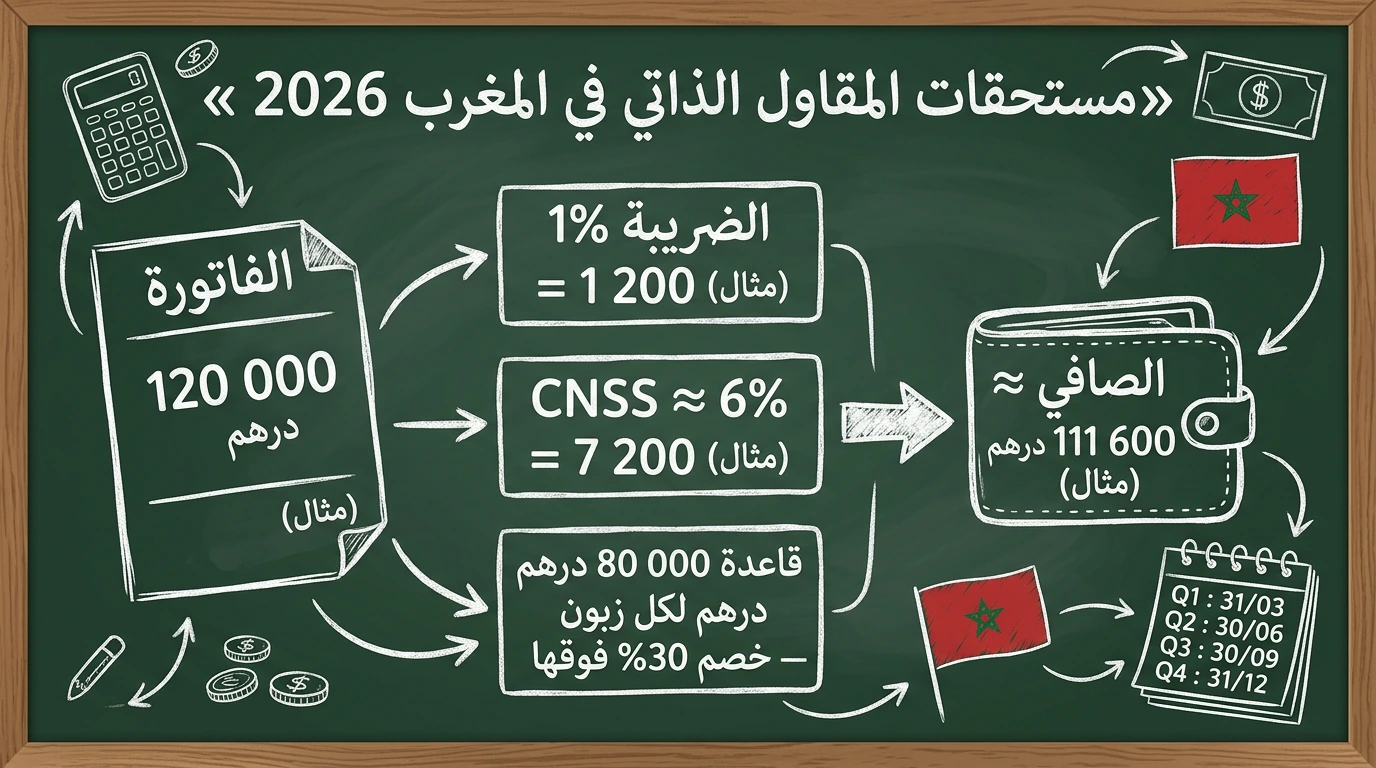
You invoice and collect 120,000 MAD of services in 2026 (example), all with different clients so the 80,000 rule does not apply. Flat tax: 1% × 120,000 = 1,200 MAD (example). CNSS: about 6% × 120,000 = about 7,200 MAD (example, bracket-dependent). Total dues: about 8,400 MAD (example). What really lands: about 111,600 MAD (example).
If instead one client paid 100,000 MAD of that (example), the 20,000 MAD excess would suffer 30% withholding (6,000 MAD, example) on top of the 1% — a strong reason to invoice several clients.
- IR flat: 1% × 120,000 = 1,200 MAD (example)
- CNSS: about 6% × 120,000 = about 7,200 MAD (example)
- Total dues about 8,400 MAD; net about 111,600 MAD (example)
- One client above 80,000 MAD: +30% withholding on the excess (example)
Budgeting with irregular income
Auto-entrepreneur income is irregular by nature: base your fixed expenses on your lowest month over the last six, not on your best one. A simple habit: save 10% of every invoice as soon as it is collected — that covers the flat tax, the CNSS and a buffer.
Track invoices and expenses in dirhams as they happen with expense tracking, keep your total picture in net worth, and build a monthly budget around your realistic average. With inflation around 2% in 2025 (Bank Al-Maghrib, bankalmaghrib.ma, accessed October 2026), your dues in dirhams barely move — the turnover is what changes.
- Fixed costs based on the lowest month of the last six
- Save 10% of each invoice on collection day
- Track everything in MAD; compare with the net salary guide
Start today: the checklist
Register for free on ae.gov.ma, affiliate to the CNSS, open a separate account for dues, and set your four quarterly declaration reminders. Then invoice, declare what you actually collected, and pay the flat tax plus CNSS on time.
Keep the status healthy: stay under your ceiling, stay under 80,000 MAD per client, never skip a zero declaration. And budget from what remains after dues — not from the invoice total.
- Register on ae.gov.ma + CNSS affiliation
- Separate account for dues; four quarterly reminders
- Stay under the ceiling and under 80,000 MAD per client
Decision check: separate turnover, tax reserves and spendable income
For an auto-entrepreneur, turnover is not the same as personal money available to spend. Set aside the expected tax and any required contributions as soon as client payments arrive; also reserve cash for business costs and refunds before drawing a personal allowance.
Do not rely on an older article’s rates, eligibility ceilings or filing deadlines without confirming the current official Moroccan rules for your activity and period. Keep copies of declarations and payment receipts. For a variable-income budget, build essential spending around received cash, not invoices you hope clients will pay.
SmartJib
Frequently asked questions
What does an auto-entrepreneur pay in Morocco in 2026?
A final flat income tax on collected turnover — 0.5% for trade/industry/crafts, 1% for services (tax.gov.ma, accessed October 2026) — plus CNSS contributions of about 6% of declared turnover, with a minimum of about 1,200 MAD a year even with no revenue (cnss.ma, accessed October 2026). On 120,000 MAD of services (example), that is 1,200 MAD of tax plus about 7,200 MAD of CNSS (example).
What are the 2026 turnover ceilings for an auto-entrepreneur?
500,000 MAD a year of collected turnover for commercial, industrial and craft activities, and 200,000 MAD a year for services (tax.gov.ma, accessed October 2026). Exceeding your ceiling for two consecutive years costs you the status and moves you to another tax regime.
Does an auto-entrepreneur pay CNSS with zero revenue?
Yes. CNSS affiliation has been mandatory since 2021 (law 98-15), and a minimum contribution of about 1,200 MAD a year — about 300 MAD per quarter — is due even with zero turnover (cnss.ma, accessed October 2026). You still have to file a zero quarterly declaration on ae.gov.ma.
What is the 80,000 MAD per-client rule?
For services invoiced to the same client, the share of annual turnover above 80,000 MAD is subject to a 30% withholding at source by that client, instead of the 1% flat rate (finance law 2023, tax.gov.ma, accessed October 2026). On 100,000 MAD from one client (example): 800 MAD at 1% plus 6,000 MAD withheld at 30% on the 20,000 MAD excess (example).
Does an auto-entrepreneur charge VAT in Morocco?
No, as long as the turnover ceilings are respected: the status is outside the VAT scope, so you neither charge VAT nor recover it on purchases (tax.gov.ma, accessed October 2026). You also benefit from a five-year exemption from the taxe professionnelle and from light accounting duties.
SmartJib keeps budget envelopes separate from bank, home, and wallet balances.
Also: Budget tracker MAD guide · 4 budgeting methods explained · Why SmartJib is private by design
Educational content, not financial advice. Figures are worked examples; verify rates and rules with the official source. Editorial policy.