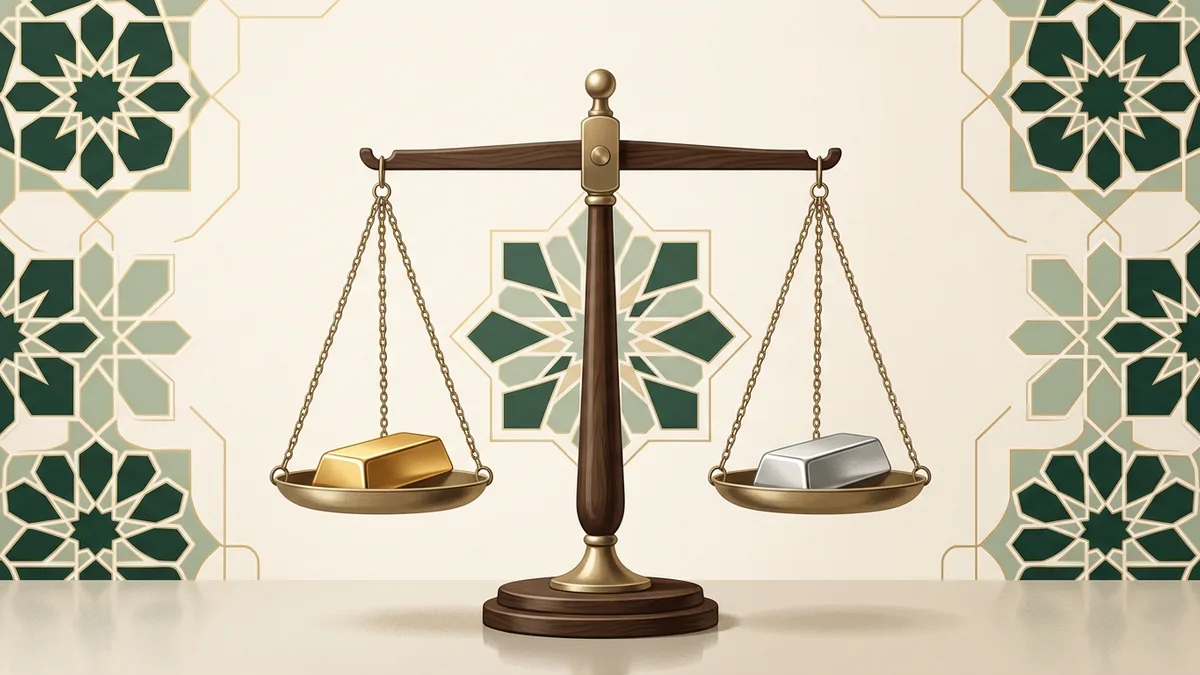
What is the nisab?
Nisab is a minimum wealth threshold used in assessing zakat. It is not a fixed amount in dirhams, euros or dollars: its monetary value changes with the metal price and the measurement convention used.
The threshold is one condition among others. Meeting it today alone does not prove a complete hawl or determine the treatment of every asset.
Gold and silver are different bases
Common approximations are 85 grams of gold and 595 grams of silver, although authorities use different weight conversions. The two thresholds can differ considerably in currency value; consult the school or qualified scholar whose guidance you follow rather than assuming one is universal.
A threshold based on one metal is a comparison value, not a requirement to own that metal. The applicable treatment can also depend on the kind of wealth held.
Turn a price into an example threshold
For illustration only, imagine gold costs 900 MAD per gram. Using 85 grams gives 85 × 900 = 76,500 MAD. This is arithmetic for a fictional price, not a current market quote or a religious ruling.
Use a current price and the purity and weight convention relevant to your assessment. Record the currency, price date and source; a jewellery purchase price can include workmanship and should not automatically be treated as pure metal value.
Compare the right amount
List the assets included under your chosen approach and subtract only eligible liabilities. Compare the resulting net amount with the relevant threshold. Keep currencies consistent and avoid counting money twice when a savings goal is already in an account balance.
A lower or higher threshold does not itself decide whether a full lunar year has elapsed. Historical balances and historical metal prices matter to timing; a current snapshot cannot establish continuous eligibility.
Check before relying on an estimate
Different interpretations address jewellery, mixed metals, debts and fluctuations differently. The calculation should show which basis and choices were used so you can discuss them with a qualified scholar.
In SmartJib, enter or review the selected metal price and date, then check the calculation. A saved price may become stale, so verify it again on your assessment date.
Keep the price and units consistent
A price quoted per ounce is not a price per gram. Convert units carefully and check whether the quote refers to pure metal or another purity. If you convert from another currency, use a clearly dated exchange rate and record any assumptions.
Do not treat the fictional 900 MAD example as today’s price. Market quotes change, and an old saved value can produce a misleading comparison. Check the source again before using the result for a real assessment.
Nisab questions to take to a scholar
Ask which metal basis and weight conversion are appropriate to the assets you hold and your chosen school. If you have mixed gold, silver and cash, ask how they should be combined; simply adding every market value may not express every school’s approach.
Bring your dated inventory, price source and records of changes in wealth. The threshold comparison is just one part of the discussion: debt deductions, ownership and the timing of the hawl may also change the result.
Turning a price into a cash threshold
The nisab is the minimum amount of wealth on which zakat becomes due once you have held it for a full lunar year. It is usually expressed as a quantity of gold or silver, or as the equivalent in cash, at the market price on the day you do the calculation.
To get a cash threshold from a gold price: multiply the price per gram by 85 grams (gold standard) or by 595 grams (silver standard), then compare the result with what you own. Each calculation uses a different price and gives a different threshold, so write down the price and the date you used.
- 85 grams of gold or 595 grams of silver
- Gram price from an official source on the calculation day
- Compare the resulting threshold with your total assets
- Write down the price and date next to the calculation
What if the price moves during the year?
Prices move constantly. Use the price of the day you actually do the calculation, not the price of the day you read this article. Read the price on the day you calculate, and use that same price for the threshold and for comparing your assets.
If the price drops after you calculated, the calculation is not automatically redone. Watch the date of the next hawl or any major change in your assets, and review with a trusted religious source.
- Use the price of the calculation day itself, not the article's day
- Compare the threshold and the assets on the same day
- Note the price used
- Review the calculation after a major change in assets
When the nisab changes with the currency
If you live between two currencies, euros and dirhams for example, convert the nisab into your currency on the same day as the calculation. Do not compare a threshold converted at an old rate with assets valued at a new one.
Write the exchange rate and its date next to the nisab. If the rate moves a lot, redo the calculation at the next hawl date.
- Convert the nisab into your currency on the calculation day
- Note the exchange rate and its date
- Compare the nisab and the assets on the same day
- Redo the calculation if the rate moves a lot
SmartJib
Frequently asked questions
Is there one fixed nisab in MAD?
No. A metal-based threshold changes with the relevant price and weight convention. Check the applicable basis and current price.
Must I own gold to use a gold-based threshold?
No. A gold-based threshold can be expressed as a value in your currency; seek guidance on the basis appropriate to your wealth.
Which nisab do I use if gold and silver give different answers?
Use the nisab that a trusted religious source considers most appropriate for your situation — often the lower cash nisab. Do not average them yourself (example guidance).
Does the nisab change every year?
Yes, because it is tied to the price of gold or silver. When prices change, the threshold changes, so read the current price at each hawl (example).
SmartJib keeps budget envelopes separate from bank, home, and wallet balances.
Also: Budget tracker MAD guide · 4 budgeting methods explained · Why SmartJib is private by design
Educational content, not financial advice. Figures are worked examples; verify rates and rules with the official source. Editorial policy.