If fixed percentages feel abstract, you can compare it with zero-based budgeting in SmartJib.
What you will find in this article
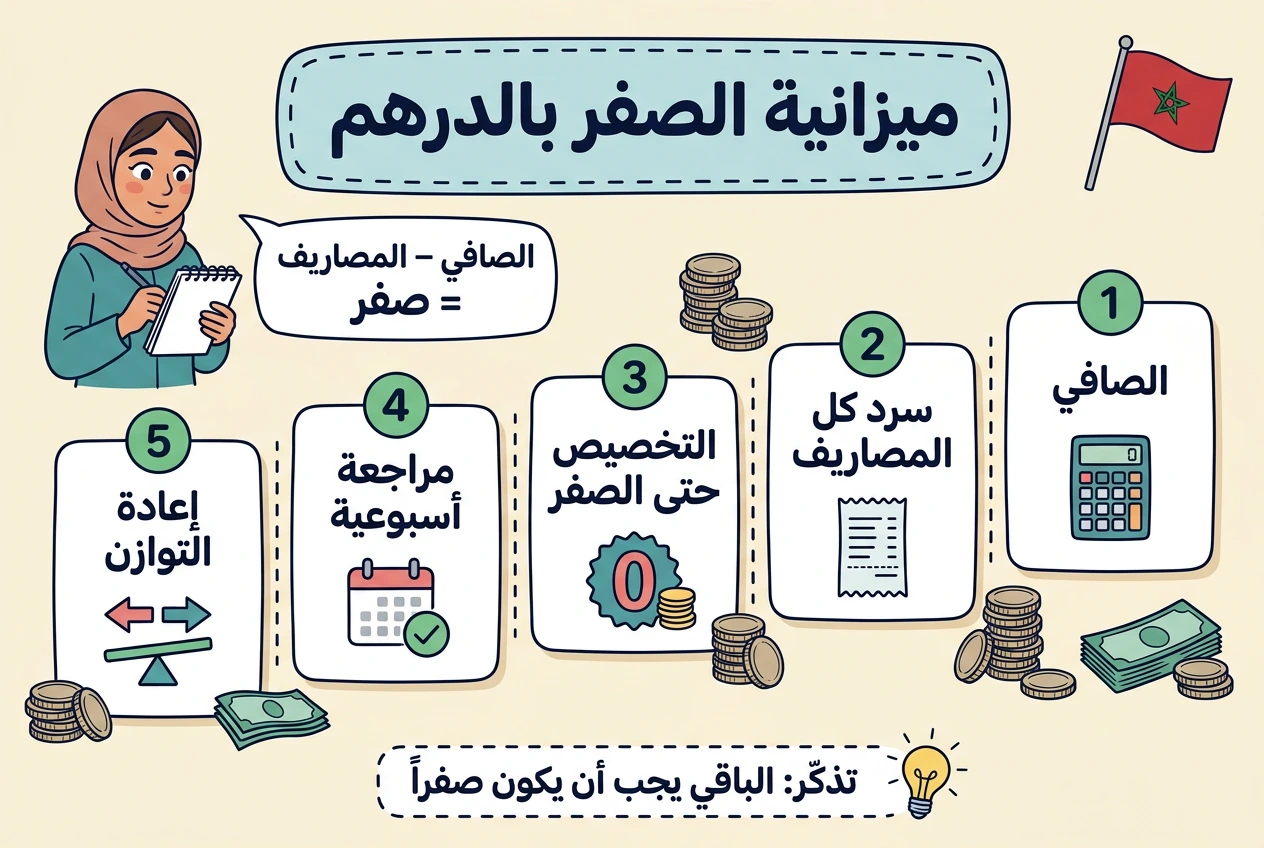
Zero-based budgeting starts from a simple promise: income minus expenses equals zero. Not "whatever is left", but zero on purpose — every dirham of your salary gets a job (needs, wants, savings, debt) before the month starts. On 8,000 MAD net in Morocco, that means listing exactly where all 8,000 MAD go, cash included. This article explains the method, walks through the 8,000 MAD example, and shows how to run it week by week without spreadsheets.
- The zero-based rule in one sentence
- A worked example on 8,000 MAD net per month
- How to list expenses when much of life is cash
- Common mistakes that break the zero
- How to review and rebalance weekly
The one rule of zero-based budgeting
Write your net income at the top. Under it, list every planned expense — rent, groceries, transport, fun, savings, debt — until what remains unassigned is exactly zero. If 500 MAD remain, they are not "left over": give them a job, usually savings or a buffer.
The method was popularised by the budgeting app YNAB and works especially well when income is irregular, because you budget what you actually have, not what you hope to earn. In Morocco, where many people combine a salary with side income, budget the salary first and treat extra income as a bonus.
Why it suits Moroccan households
Moroccan spending is a mix of bank payments (rent, subscriptions) and cash (souk groceries, small taxis, cafés). Zero-based budgeting forces both onto the same list, so cash stops being the blind spot.
It also pairs naturally with the envelope method for the cash part: assign 2,400 MAD to wants (example), withdraw it, and when the envelope is empty the spending stops. Household surveys put food and housing at the top of Moroccan budgets (HCP 2024, hcp.ma, accessed October 2026).
- Bank payments and cash on the same list
- Food and housing are the biggest lines (HCP)
- Works with envelopes for the cash part
- Ideal when income is irregular
Worked example: zero-based on 8,000 MAD
Net income 8,000 MAD (example). Assign: needs 4,600 (rent 2,500 example, groceries 1,000, transport 400, utilities and phone 400, school 300), wants 1,800, savings 1,200, debt repayment 300, buffer 100. Total assigned: 8,000. Remaining: 0.
The order matters: needs first, then minimum debt payments, then savings, then wants with what is left. If wants need more than what is left, the plan is telling you something true: this salary does not cover this lifestyle yet.
- Needs 4,600 MAD: rent 2,500, groceries 1,000, transport 400, utilities 400, school 300 (example)
- Savings 1,200 MAD before wants
- Wants 1,800 MAD — with what is left
- Debt minimums 300 MAD + buffer 100 MAD
- Income 8,000 minus assigned 8,000 = 0
Step 1: collect your real numbers
Gather the last three months: the net amount on your payslip, rent, recurring bills, and a rough average of cash spending. In Morocco, cash spending is usually underestimated, so add 20% to your first guess (example heuristic drawn from household consumption surveys, HCP, hcp.ma, accessed October 2026).
If you already track expenses in an app, export the last three months (SmartJib exports your data as CSV or JSON) and average by category. If not, one week of noting every expense is enough to see the pattern.
- Net income from the payslip, not the contract
- Last three months of bills and cash averages
- Add 20% to your first cash guess
Step 2: list every expense, bank and cash
Write down fixed expenses first: rent, loans, insurance, subscriptions, school. Then variable needs: groceries, transport, fuel, pharmacy. Then wants: restaurants, outings, shopping. Finally savings and any debt above the minimum.
Give cash its own lines, not one vague "miscellaneous". Souk groceries, small taxis, café coffees — each gets a line with a monthly estimate. This is the step that makes zero-based budgeting work in a cash-heavy economy.
- Fixed first: rent, loans, school, subscriptions
- Then variable needs: food, transport, health
- Then wants: each with its own line
- Cash gets real lines, not "miscellaneous"
Step 3: assign until the remainder is zero
Start from income, subtract each line, and watch the remainder shrink: 8,000, then 3,400, then 2,400, then 600, then 0. When it hits zero, stop. Anything still unlisted has no money — that is the point.
If the remainder goes negative before you finish, you have two honest options: remove or shrink want lines, or increase income. Do not silently "borrow" from the savings line.
- Subtract line by line from income
- Stop at zero
- Negative remainder: cut wants or earn more
Step 4: run it weekly, not monthly
A monthly budget reviewed once a month fails quietly. Instead, every Sunday spend five minutes: check each line against reality, move small leftovers between lines, and note next week’s fixed payments.
In SmartJib, categories and places stay separate: a category says what the money is for, a place says where it sits (bank, home, wallet). Logging a 30 MAD coffee takes seconds and keeps the wallet honest.
- Five minutes every Sunday
- Move leftovers between lines
- Log cash the same day
- Check next week’s fixed payments
When zero-based budgeting gets hard
Some months are simply hard: a wedding, a medical bill, Ramadan, a repair. The method does not forbid these — it makes you choose them consciously and pay from a line (a "true expenses" buffer of 200 to 500 MAD per month, example) instead of from the card and hope.
If you keep missing the plan, the plan is wrong, not you. Common fixes: overestimated cash lines, forgotten subscriptions (check your bank SMS alerts — Moroccan banks send one per operation, example), or a rent that eats half the salary (HCP 2024, hcp.ma, accessed October 2026). With inflation low — around 2% in 2025 (Bank Al-Maghrib, bankalmaghrib.ma, accessed October 2026) — the usual leaks are subscriptions and cash, not prices.
Keep it shame-free: adjust the numbers, keep the habit. A zero-based budget you tweak monthly beats a perfect one abandoned in week two.
- Build a 200–500 MAD "true expenses" buffer (example)
- Check subscriptions via bank SMS alerts
- Rent above 40%? adjust the plan
- Adjust the plan, never blame yourself
Zero-based budgeting with SmartJib
SmartJib is built around exactly this split: categories for what money is for, and separate balances for where it is (bank, home, wallet). At onboarding you pick a strategy and the categories, expenses and goals are pre-filled for you; then you log expenses in seconds and set savings goals with a name and a target amount.
Export your data anytime as CSV or JSON, and delete your account whenever you want — your numbers are yours. Start with one week of logging, build the first zero-based month from real numbers, and adjust from there.
- Categories = what money is for
- Bank, home and wallet = where it sits
- Export CSV/JSON and delete anytime
Decision check: the plan reaches zero, not the bank balance
A zero-based budget assigns every unit of available money to a job, including savings and a buffer. The formula is available income minus planned allocations equals zero; it does not mean withdrawing or spending all the cash in your accounts.
If you receive 8,000 MAD, write allocations that total exactly 8,000 MAD and keep funds for future bills accessible. When groceries go over budget, reduce another genuinely uncommitted allocation by the same amount. The separate question is whether the account or wallet can actually make the next payment.
SmartJib
Frequently asked questions
What does zero-based budgeting actually mean?
Income minus expenses equals zero — every dirham is assigned to a job (needs, wants, savings, debt) before the month starts. A positive remainder means unassigned money; a negative one means the plan is impossible as written.
Is zero-based budgeting better than 50/30/20?
They answer different questions. 50/30/20 is a quick split rule of thumb; zero-based budgeting assigns every single dirham, which makes it better for irregular income and cash-heavy spending — common in Morocco. Many people use 50/30/20 as the split inside a zero-based plan.
How do I budget cash in Morocco with the zero-based method?
Give cash its own budget lines (souk, taxis, cafés) with monthly estimates, withdraw them as weekly envelopes, and log every cash expense the same day. Keep the wallet as a separate balance from your bank account so the two never get mixed.
What if I have debt?
Minimum debt payments go in needs. Any extra repayment is its own line, ranked with savings. Do not zero out the savings line entirely just to pay debt faster — a small emergency fund prevents new debt when surprises arrive.
Can I start zero-based budgeting mid-month?
Yes. Budget the remainder of the current month first, then run full months. One week of honest logging is enough to build a realistic starting plan.
SmartJib keeps budget envelopes separate from bank, home, and wallet balances.
Also: Budget tracker MAD guide · 4 budgeting methods explained · Why SmartJib is private by design
Educational content, not financial advice. Figures are worked examples; verify rates and rules with the official source. Editorial policy.