Give cash a category and a location
A zero-based cash budget needs two answers for each purchase: what was it for, and where did payment come from? Categories such as groceries describe the purpose. Bank, home cash and wallet describe where the money sits.
The same category can be funded across several locations. Reserving 1,000 MAD for groceries does not mean all 1,000 must be in an envelope. Part can stay at the bank for card payments while part is carried as cash. The allocation still totals 1,000.
An ATM withdrawal is a transfer
Imagine you move 1,000 MAD from your bank account into your wallet. Your bank balance decreases by 1,000 and wallet balance increases by 1,000. Total money is unchanged, so do not count the withdrawal as groceries or other spending.
If the withdrawal has a fee, record the fee separately as an expense. A 10 MAD fee means your total money falls by 10, even though the transferred 1,000 is still yours. Keep the transfer and fee distinct so neither is hidden.
Follow the wallet through one week
These are fictional amounts, chosen to show the arithmetic. Start with an empty wallet, then withdraw 1,000 MAD. Each actual purchase reduces the wallet and uses its category allocation.
- Wallet after withdrawal: 1,000 MAD.
- Groceries paid in cash: 280 MAD; wallet now 720.
- Transport paid in cash: 70 MAD; wallet now 650.
- Café paid in cash: 50 MAD; wallet now 600.
- Total spending: 400 MAD, not 1,400.
- Expected cash remaining: 600 MAD.
Physical envelopes need the same funded limits
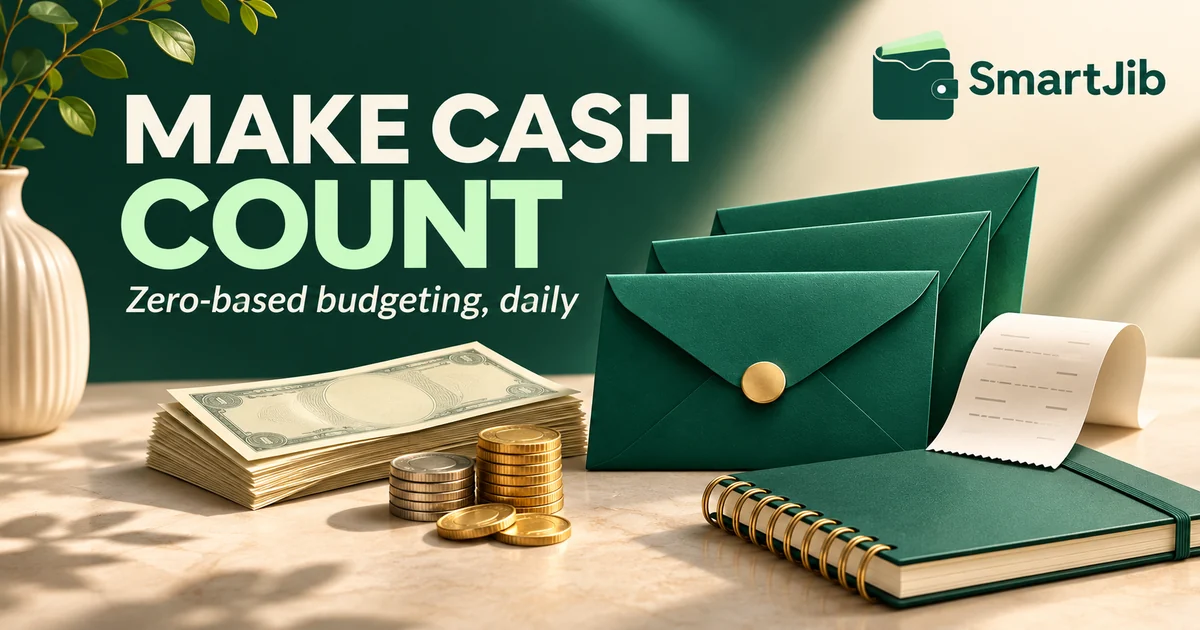
Split cash into envelopes if that helps: groceries, transport and optional spending are enough for a first week. Write the starting allocation on each envelope. When you pay, record the purpose and the amount.
Moving 50 MAD from the optional envelope to groceries changes the plan. It does not create income. Reduce the optional allowance by the same 50. If envelopes and app records both exist, choose one consistent routine for recording the move so you do not double-adjust.
Reconcile cash without inventing missing purchases
At a weekly check, count notes and coins. If your records expect 600 MAD but the wallet contains 570, there is a 30 MAD difference. Check change, missed receipts and cash moved to another place before changing the records.
When you cannot identify it, record a clearly labelled cash adjustment using your tracking method's supported workflow. Do not silently call it groceries just to make the totals match. Update the relevant plan allocation so the missing money no longer appears available for another job.
Handle mixed payments and refunds carefully
If a 120 MAD grocery purchase is paid 70 in cash and 50 by card, the grocery category uses 120 while the two locations fall by their respective amounts. Do not record two separate 120 MAD purchases.
A refund reverses part of the original spending and returns money to the location where you received it. Treating it as earnings can distort your income view. Check how your tracking tool handles refunds, and keep a note if a manual correction is needed.
Make recording small purchases sustainable
Record purchases when you can, then use a short daily check for forgotten amounts. If recording every café separately is burdensome, use a consistent daily total per category and payment place with a supporting note. Consistency is more useful than an elaborate routine you abandon.
SmartJib distinguishes what money is for from bank, home and wallet balances. Review the related purpose-versus-location guide below. Start with the wallet you actually use, and reconcile before deciding the remaining cash is free to spend.
Weekly cash reconciliation in five minutes
Once a week, count what is actually in the wallet and compare it with the tracker: opening balance, minus recorded cash spending, plus any cash received. If the count is lower, the gap is unrecorded spending — do not invent purchases to fill it, just note the gap as a reminder that the habit needs tightening.
A small recurring gap is normal; a growing one is a leak. Reconciling weekly keeps the gap small and makes the numbers trustworthy again without shame. The goal is an honest record, not perfect memory.
- Count the wallet once a week
- Compare with opening balance minus recorded spending
- Note any gap instead of inventing purchases
- Fix the habit, not the history
Digital tools that respect cash-first tracking
A cash-first budget app should let you record a cash expense in seconds and show the wallet as its own balance alongside the bank. That separation is what makes transfers visible: moving money from bank to wallet changes a location, not the plan.
Check that the app lets you export your full history (CSV or JSON) and works without any bank connection. If you ever switch tools, your records should come with you — they are yours.
- Record cash expenses in seconds
- See the wallet as a separate balance
- Transfers must not appear as spending
- Full export (CSV/JSON), no bank connection required
SmartJib
Frequently asked questions
Is taking money out of an ATM an expense?
The withdrawn amount is a transfer between your own money locations. Any ATM fee is a separate expense. Record actual purchases when the cash is used.
Can I combine envelopes with card payments?
Yes. Keep one category allocation and record spending from each payment location. The combined cash and card spending must remain within that category's funded allowance.
What if my cash count does not match the tracker?
Check missed purchases, change and transfers first. If the difference cannot be identified, use a labelled adjustment and update your available funding rather than hiding it in an arbitrary category.
How much cash should I keep in the wallet?
Keep a deliberate, fixed limit — for example one week of small daily purchases (example amount). When the wallet runs low, withdraw a planned amount as a transfer, never as an expense. A limit you chose is easy to defend; a vague one is not.
What if I forget to record a purchase?
Record it as soon as you remember, even if the day is off. If you cannot remember at all, note an estimated 'unrecorded cash' entry during the weekly reconciliation rather than pretending it did not happen.
SmartJib keeps budget envelopes separate from bank, home, and wallet balances.
Also: Budget tracker MAD guide · 4 budgeting methods explained · Why SmartJib is private by design
Educational content, not financial advice. Figures are worked examples; verify rates and rules with the official source. Editorial policy.