Cash in the wallet needs its own tracking — learn how to track cash spending without mixing it with your bank balance in SmartJib.
What you will find in this article
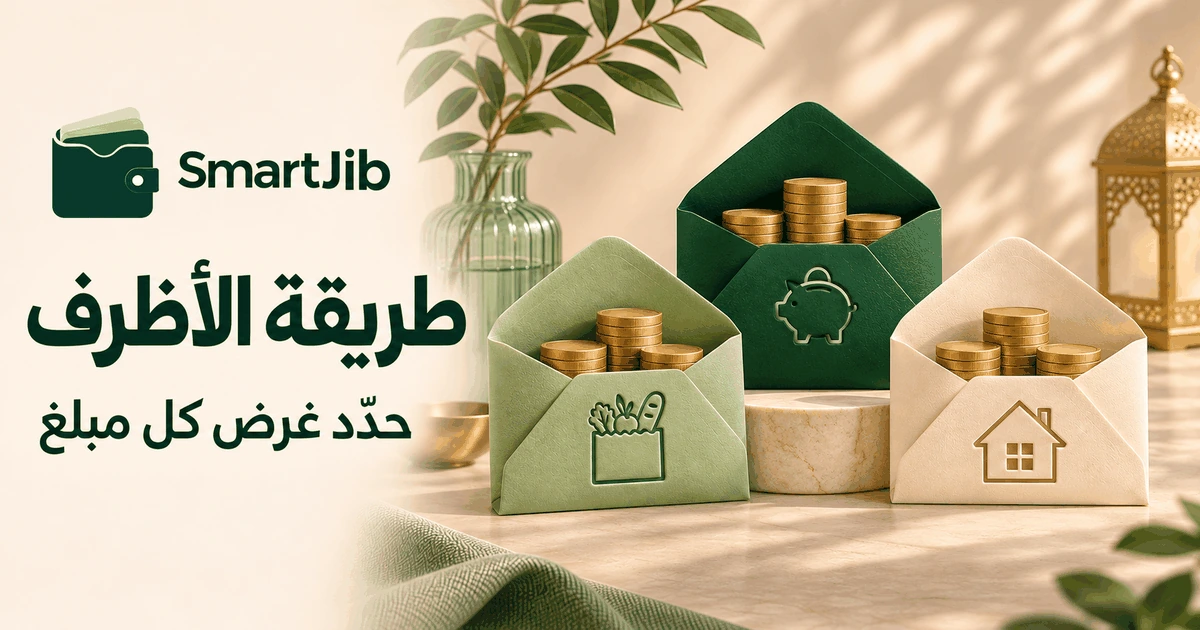
Envelope budgeting means dividing your money into physical envelopes — one per category — and spending only what is inside. In Morocco, where souks, small taxis and cafés still run on cash, this old method beats most apps: when the envelope is empty, you stop. This article explains how to set up envelopes in dirhams on an 8,000 MAD salary (example), which categories deserve an envelope, and how to survive months with surprises.
- What an envelope budget is, in one sentence
- A worked 8,000 MAD envelope plan
- Which categories get envelopes in Morocco
- Weekly envelopes vs monthly envelopes
- What to do when an envelope runs out early
Why envelopes work in a cash economy
Apps are great for bank payments, but cash has a psychology problem: notes in a wallet feel less real than a card tap. An envelope makes cash visible and finite — you can literally watch the money leave.
Moroccan households still do a large share of daily spending in cash (HCP household surveys, hcp.ma, accessed October 2026), which is exactly why envelopes keep working here in 2026.
The categories that deserve an envelope
Not everything belongs in cash. Rent, loans and subscriptions should stay on bank transfer — they are fixed and already traceable. Envelopes are for the variable, cash-heavy lines.
Typical Moroccan envelope categories: groceries and the souk, transport (small taxis, fuel), cafés and small treats, pharmacy and health, school extras, and a fun envelope for outings.
- Groceries and souk — usually the biggest cash line
- Transport: small taxis, fuel, parking
- Cafés, snacks and small daily treats
- Health: pharmacy, small consultations
- School extras and gifts — weddings happen
Worked example: 8,000 MAD in envelopes
Take 8,000 MAD net (example). Keep 4,600 MAD on bank transfer for fixed costs: rent 2,500 (example), school 300, subscriptions 200, utilities 300, loan payment 300. The remaining 3,400 MAD goes into envelopes.
A weekly split of those 3,400 MAD: groceries 1,200, transport 600, cafés and treats 400, health 300, fun 400, buffer 500. Times four weeks, that is the month.
- Fixed by bank transfer: 4,600 MAD (example)
- Groceries envelope: 1,200 MAD/month (300/week)
- Transport: 600 MAD/month
- Cafés and treats: 400 MAD/month
- Fun plus buffer: 900 MAD/month
Step 1: monthly envelopes or weekly?
Monthly envelopes suit stable categories like groceries. Weekly envelopes suit the ones you blow early, like cafés and treats. Many people mix both.
Start monthly for the first two months, then move the leaky categories to weekly. Do not overcomplicate the first month.
- Start monthly, keep it simple
- Move leaky categories to weekly later
- Mix both once you know your patterns
Step 2: label and fill the envelopes on payday
On payday, withdraw the cash and fill every envelope at once. Label each with its category and amount — paper envelopes cost nothing, and old ones can be reused.
In Morocco, city ATMs dispense up to a daily limit that varies by bank (commonly a few thousand dirhams — check your bank’s terms, for example on bankalmaghrib.ma’s bank directory or your bank’s site, accessed October 2026). Plan one withdrawal a month, or use the counter for the full amount.
- Withdraw once a month if you can
- Label every envelope with category and amount
- Check your ATM daily limit
- Keep one unlabeled buffer envelope
Step 3: spend only from the right envelope
When you pay at the souk, the money leaves the groceries envelope — not the fun one. If you pay by card, log it against the same category so the cash left in the envelope stays accurate.
Log each expense the same day, even a 30 MAD coffee. In SmartJib you log cash against the wallet place and the right category, and the app keeps bank, home and wallet as separate balances.
- Pay cash from the right envelope
- Log card payments against the same category
- Log every expense the same day
Step 4: handle transfers between envelopes
Sometimes the groceries envelope has 200 MAD left and health needs 150. Move it explicitly and note it — silent transfers are how envelopes start to lie.
At month end, empty leftovers go to savings, not into next month’s fun. This is how the envelope method quietly builds a buffer.
- Move leftovers explicitly, never silently
- Note every transfer in one line
- Month-end leftovers go to savings
- Never borrow from next month
When envelopes get hard
Weddings, Eid, Ramadan, back-to-school — Moroccan life has predictable spending spikes. Give them their own envelope all year (300 MAD per month into a "gifts and occasions" envelope, example) so Eid does not wreck the plan.
If you keep breaking envelopes, the amounts are wrong, not your willpower. Re-estimate from three months of real spending and add 20% to your first guess (heuristic drawn from HCP consumption data, hcp.ma, accessed October 2026). With inflation around 2% in 2025 (Bank Al-Maghrib, bankalmaghrib.ma, accessed October 2026), prices are rarely the culprit — the envelopes are.
Combine methods: envelopes for cash, a zero-based or 50/30/20 plan for the bank side. Track bank, home and wallet as separate balances in SmartJib so every transfer stays visible.
- Occasions get their own envelope (300 MAD/month, example)
- Re-estimate from real spending, plus 20%
- Envelopes for cash + 50/30/20 or zero-based for bank
- Keep bank, home and wallet separate
Start small: one envelope this week
You do not need twelve envelopes on day one. Start with the one category that always leaks — usually cafés and small treats — and run it for four weeks. Add one envelope per month as the habit sticks.
Log every expense in seconds in SmartJib (category plus wallet place), export your data as CSV or JSON anytime, and keep full control of your account. Small start, real numbers, no shame.
- One leaky category first
- Add one envelope per month
- Log in seconds, export anytime
Decision check: never refill an envelope by counting a transfer as income
An envelope is a spending limit, whether you keep physical notes or track a digital category. Moving cash from the bank into a physical envelope only changes its location; it does not increase the money available to your budget.
If a groceries envelope is short by 150 MAD, first ask which other envelope has 150 MAD genuinely uncommitted after outstanding bills. Record a 150 MAD allocation transfer, leave actual purchases untouched and reduce the donor envelope. If no envelope has spare funding, reduce or delay spending instead.
SmartJib
Frequently asked questions
Do I need real paper envelopes?
Any labeled container works — paper envelopes, jars, even rubber-banded stacks of notes. The point is separation: each category has its own physical pile, so overspending becomes visible.
What if my salary is irregular?
Budget on the lowest month of the last six, put that base into envelopes, and send any extra income straight to savings. Envelopes work best on a stable base amount.
Can I use envelopes and an app together?
Yes — that is the recommended combo in Morocco. Envelopes for cash, the app for bank payments. SmartJib keeps bank, home and wallet as separate balances and categories for what money is for, so the two views never mix.
What happens when an envelope is empty?
You stop spending in that category, or you explicitly move money from the fun envelope and note it. Never silently refill from fixed costs — that is how rent money disappears.
Is envelope budgeting still relevant in 2026?
More than ever in a cash-heavy economy. Cards did not fix cash psychology; a physical envelope did. Use envelopes for cash and any simple plan for the bank side.
SmartJib keeps budget envelopes separate from bank, home, and wallet balances.
Also: Budget tracker MAD guide · 4 budgeting methods explained · Why SmartJib is private by design
Educational content, not financial advice. Figures are worked examples; verify rates and rules with the official source. Editorial policy.